
Waste management is one of the most critical environmental challenges in the 21st century. As cities are growing and consumption is increasing. Waste management does not only refer to having an outer cleaning but also having the inner safety and protection from the various health hazards that are developing because of improper waste management and traditional methods. With a growing population and industrialisation, the amount of waste generated every year is insane. By 2050 it is expected that global waste generation will be 3.4 billion tons per year. Traditional waste methods can not handle such huge waste production which is why they are struggling to keep up. This situation leads to pollution, overflowing of trash yards and serious health risks. To overcome this concern, we need an advanced solution that can manage the issue smartly.
This is where AI steps in with smart, data driven solutions. Artificial Intelligence is no longer just a trending word that people usually bring into their daily life, it is becoming a powerful tool in solving some of the world’s most serious environmental challenges. The main problem in the world is waste management. With the help of advanced technologies like machine learning, sensors and real time data analysis, AI is changing how trash is collected, separated, recycled, and reduced. It helps in improving efficiency, reducing environmental effects and supporting a more valuable future. In this article, we will study how AI helps in waste management services, making them cleaner, smarter and more sustainable for generations to come.
Waste Types and Their Production
Waste is one of the biggest enemies to a healthier environment due to its contribution to generating great pollution in the air, water and land. These wastes are generally generated by rapid popularisation, urbanisation, industrial production, construction projects, agricultural activities and consumerism. This can lead to many risks like environmental degradation, health issues, economic loss and loss of resources associated with waste removal. Waste has been divided into different forms based on form, source and level of hazard.
Types of Waste by Sources
- Municipal Solid Waste
Waste generated from houses, restaurants and office cleaning, including food, packaging, paper, garments and other items.
- Industrial Waste
Waste generated from manufacturing, mining and other industrial projects, including metal scraps, ash, chemical products and many others.
- Construction and Demolition Waste
Waste generated from construction, house renovation and demolition, including heavy and large waste like wood, metal, rocks and other materials.
- Unsafe Waste
Waste that contains risk to health and nature, like toxic and acidic material, including pesticides, gas cylinders, clinical waste and many others.
- Electronic Trash
Waste that has precious and dangerous substances on it such as old or damaged electronic items, including phones, laptops, computers and others.
- Agricultural Waste
Organic waste that is generated from farming and cropping, including manure, crop residues, damaged food and many others.
Types of Waste by Physical State and Biodegradability
- Solid Waste: Paper, garments, plastic, rubber, rocks and other.
- Liquid Waste: Oils, sewage water, petrol, chemicals and other.
- Gaseous Waste: Gases from factories, houses and vehicles.
- Biodegradable waste: Waste that can decompose easily like organic waste including food and other items.
- Non Biodegradable Waste: Waste that can not decompose easily like plastic and glass.
Sustainable Waste Management
Sustainable waste control is important for environmental safety, resource preservation, maintaining health and safety and lowering climate change. Eco friendly waste management has changed the purpose from just removing waste to changing the trash into a useful resource. According to one of the recent reports, every year, more than two billion metric tons of municipal solid waste alone are generated all over the world. This number is predicted to increase to almost four billion tons by 2050. With the insane increasing amount of waste every year, there is a high risk of greenhouse gas emission, pollution, health hazards and many others that make the emergence of new strategies in proper waste management more important than ever.
Traditional waste management services including landfilling, burning and other methods can generate harm to the environment and the surrounding community. Each year, almost 9 million people die due to diseases connected to poor waste management and pollution which is 20 times higher than deaths generated by malaria. Traditional waste solutions ignore a sustainable approach and result in the loss of many useful resources that can be recycled with better techniques.
Artificial intelligence in waste management
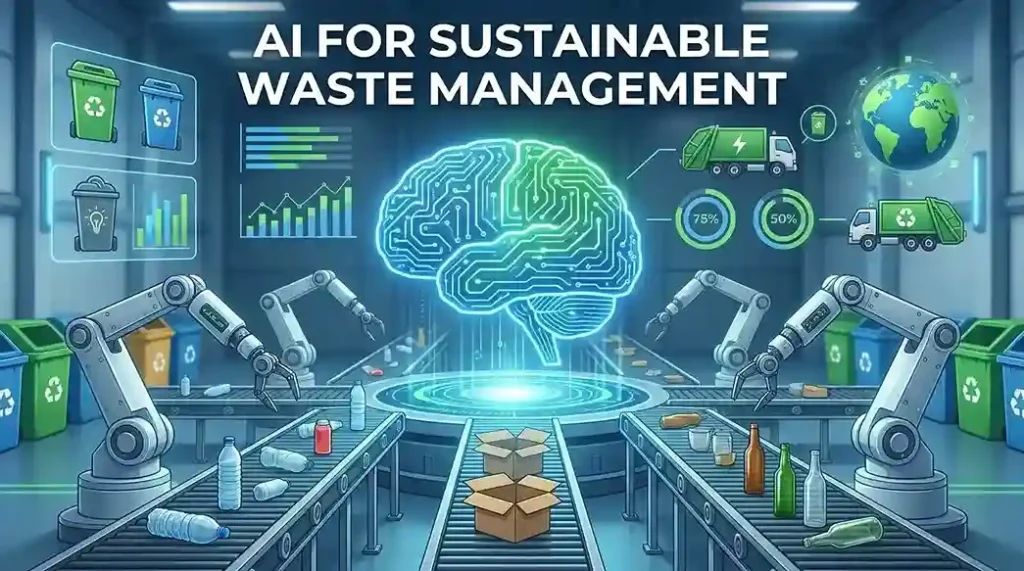
Modern problems demand modern solutions that make Artificial Intelligence the most suitable choice for waste removal. The partnership between Artificial Intelligence and waste management has proven a promising match for long lasting development. Manywaste management companiesactively use AI technologies to deal with many environmental challenges, including waste removal. The emergence of AI in waste management services has completely changed the viewpoint on process, handling and recycling of waste.
Artificial Intelligence encourages sustainable waste management by increasing efficiency, accuracy and data-driven decision making throughout the entire waste management cycle of generation to disposal. AI technologies like Robotics, Machine learning, Computer Vision and the Internet of Things reduce the dependency on landfilling and operational costs by 10 to 15 per cent and help in improving recycling by 20 to 30 per cent.
Key Points AI Supports Sustainable Waste Control
- AI Powered Waste Sorting and Recycling
One of the frustrating and difficult tasks in waste management is the separation of the waste. Traditional waste management uses manual sorting that takes a lot of time, effort and money and does not guarantee accuracy and efficiency. That is where AI entered as a lifesaver. AI powered waste sorting has improved the accuracy rate from 60% to 90%. AI powered waste sorting and recycling uses computer cameras and robots to separate the waste much more easily and quickly than humans. Unlike traditional methods, AI scans the waste type from skip bins as it moves within a second, identifies them and separates them for better dumping. It can even scan and separate the smallest item without getting tired and guarantees a 100 per cent accuracy rate. It provides less landfill waste, proper recycling and smart collection.
- Smart Waste Collection and Route Optimisation
Smart Waste Collection and Route Optimisation is an advanced way of handling trash with the help of modern technologies to make waste collection much faster, easier and cheaper than earlier. Instead of a driver of waste management companies driving trucks on the same route every day, even if the skip bins are not filled, the AI system uses data to collect waste when it is needed. RapidBins have a sensor on them that measures how much they have filled and sends a message through wires to the central computer that helps inform when to pick them up for disposal. The computer uses the information and maps out the best and fastest route for the driver only to the filled skip bins. It helps in skipping empty bins and prevents overflow of waste. It reduces pollution, traffic, the cost of fuel and waste of time.
- Predictive Maintenance: Makes before it Breaks
Earlier, the recycling machines and trucks used to get fixed after they broke down, but with the help of modern technology like AI sensors, they can predict the damage before it happens and provide an ultimate solution to it without creating a loss to any work. It helps in avoiding uncertainty or complications in waste management. It’s like getting a notification that your car needs a better engine so you can get it fixed instead of waiting for it to break down in the middle of the road. Smart sensors are connected to conveyor belts, separating the robots and engines of the truck. These sensors measure things like vibrations, temperature and noise and help in predicting when it will need maintenance. It saves lots of time, money and effort.
- Operational Efficiency: Works smarter, not Harder
Operational efficiency makes sure every step gets counted. AI helps in optimising every step from collecting the trash to sorting and recycling it. AI detects when it gets filled and informs the central computer, mapping out the best route for the driver directly to the filled bins and avoiding traffic and empty bins, separating waste in very little time with a high accuracy rate without taking a break or getting tired. This helps in reducing the sudden machine breakdown, traffic, high cost and wastage of time and effort. It provides a high rate of efficiency and accuracy in proper waste management. According to smart city studies, AI can lower operational costs by up to 30% and enhance recycling rates by up to 25%. AI helps in smarter waste collection and sorting and saves your hard work.
- Reducing Environmental Impact
AI has proven to be the biggest supporter in reducing environmental impact by making the waste management process much easier, faster, smarter and cleaner. AI uses smarter bins with sensors, smart sorting with the help of robots and predictive maintenance to help reduce landfill waste and illegal dumping. These tools and methods transform trash into a manageable resource, significantly lowering the environmental impact of city skip bin services. Sadly, garbage from about four billion people goes to unregulated or illegal dumpsites that hold more than 40% of global waste.
With the help of AI technology, we can support legal and eco-friendly dumping to make the world a better, cleaner and safer place for everyone to live. AI powered robots and sensors improve recycling accuracy up to 99.95 per cent, lowering collection costs by over 13 per cent and reducing landfill trash by optimising recycling processes and improving operational efficiency in smart cities.
- Improves Worker Safety
AI makes waste management safer for humans by taking away dangerous jobs from them. They help in sorting trash, removing unsafe waste and ensuring the safety of workers. AI helps in removing heavy, hard and unsafe waste, making it easier and safer for workers to lift. An AI camera watches the place 24/7 and ensures that no worker enters the dangerous area. They provide the best and safest route for drivers to collect rubbish and check if they are wearing a safety suit. Workers can work with AI powered devices that help them track their health and inform them about the danger. They predict risk, machine failure, traffic and other dangers for workers’ lives and provide them a safe working place.
- Waste Generation Forecasting
AI helps in waste generation forecasting by using smart and advanced technology to predict how much waste will be produced, when and where by analysing past data, local events, weather conditions and location. AI helps truck drivers in collecting waste by providing accurate information when the bin gets filled and saves the cost of fuel and the time of workers. It acts as a weather forecast and makes garbage management more accurate and effective. With the help of AI, it is forecasted that global municipal solid waste generation will grow by over 75 per cent by 2050. AI helps in predicting future actions and helps in preventing risk and delay. It helps cities to improve the recycling rate and reduce landfill waste, pollution, overfilling and illegal dumping.
- Improves Recycling Paces and the Circular Economy
The circular economy has changed the previous take make waste system into a new model in which waste is reused, repaired and recycled to keep it useful for a longer time. While enhancing the recycling rate means better separation of waste, it also makes the products easy to recycle and use by converting them into valuable resources. It helps in environmental protection, the growth of the economy and the efficiency of resources.
- Key points of the circular economy
- Reduce and reuse
- Recycle
- Repair and refurnishing
- Making waste into a resource
- Key points of enhancing the recycling rate
- Educate people on the right recycling process
- Investing in a better sorting system
- Creating a new product from waste
- Ensuring a better recycling process
Final thought
In today’s time, AI is not just advanced technology for research but also a powerful tool for better waste management that helps in making the world cleaner and safer for people to live. With the help of advanced AI programs, computer cameras, robots, sensors, and others, it is easy to collect, sort and recycle the waste without making it a hard task. AI helps in maintaining better waste management and skip bin services and reduces landfill waste and illegal dumping. In easy words, AI helps in improving the quality of skip bins, waste management, better sorting, ensuring worker safety, avoiding mistakes, increasing economy, accuracy and efficiency of waste management all these in an easy and fast manner without any stress and hassle. AI doesn’t just make work easier, it makes it smarter, giving people the freedom to focus on what truly matters while enjoying greater peace of mind and a more secure life.